Building PAB: two months teaching a computer to play Pokémon battles
I set out to train an AI that plays Pokémon battles, and ended up with a Chrome extension that gives you advice while you play. This is what I planned, what I trained, what failed, and what finally worked.
Pokémon Showdown is a free website where people play Pokémon battles against each other, right in the browser. It's where most competitive players practice. A battle is turn-based: each turn, both players pick an action at the same time, either one of their Pokémon's four moves or a switch to another Pokémon on their team, and then both actions happen.
PAB is an extension for Chrome that sits next to your battle and helps you decide. Each turn it shows a panel with the move it recommends and the reasons behind it: how much damage each move does, who will move first, whether you can knock out the opponent, whether they can knock you out, and what your opponent is probably carrying. It never plays for you. You still make every choice.
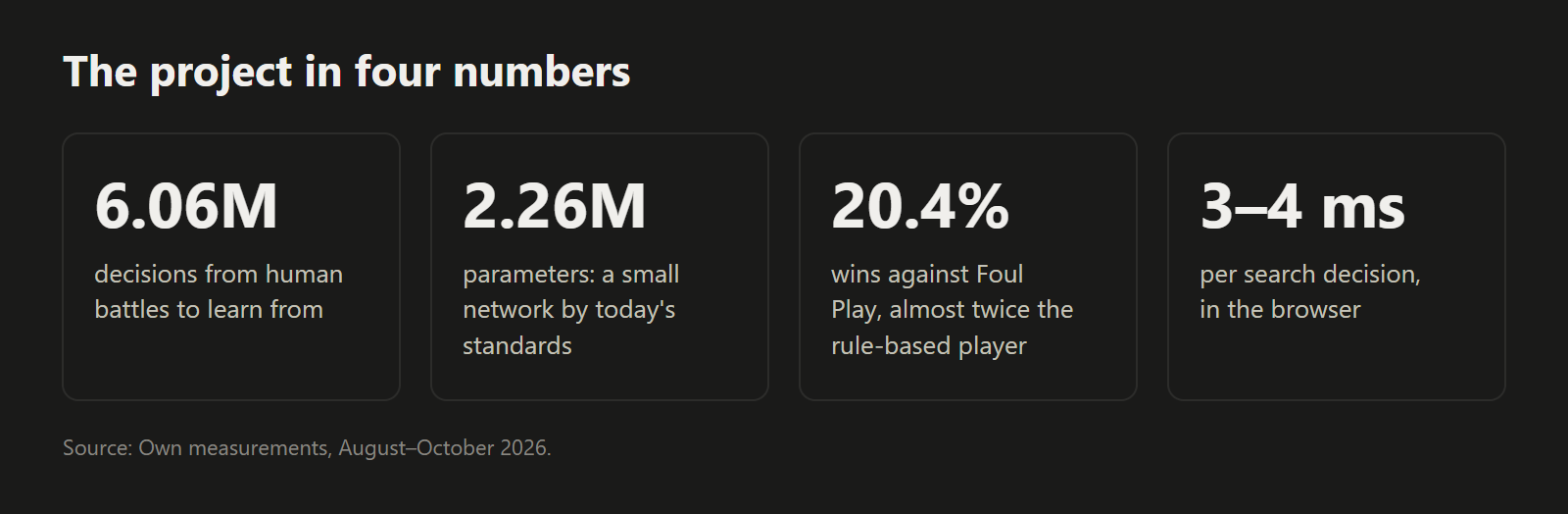
I built it in my free time between 20 August and 20 October 2026. Along the way, my own design was proven wrong several times, and the most important result only appeared after I found a bug in the code I was using to measure everything.
The original idea
The plan had two parts:
- Train a computer player that plays Showdown battles well.
- Build a Chrome extension that uses that player to recommend moves in your own battles, and explains why.
Before writing any code, I set a few rules:
- No chatbots making decisions. I didn't want a large language model like ChatGPT guessing moves. The player had to learn from the game itself.
- It should work in any format. Showdown has dozens of formats: different generations of the games, random teams, teams you build yourself, singles and doubles. I wanted one player that understands the mechanics, not one that memorized a single format.
- The extension only reads. It can look at the battle, but it can never send a move or anything else on your behalf. The build checks this automatically and fails if that rule is broken.
- Measure everything. Every idea had to be tested with real battles and numbers, and I wrote down what result would count as success before running each test, so I couldn't move the goalposts afterwards.
That last rule turned out to be the most important one.
How it went
| When | Step | Result |
|---|---|---|
| August | Check that it's possible on a home PC | Yes, with room to spare |
| August | Build the game engine and a way to test players against each other | Works, and every test is repeatable |
| August–September | Build the extension | A panel inside Showdown that only reads |
| August–September | Collect training data from real battles | 6.06 million decisions made by human players |
| Late August | Teach a neural network by copying human players | It copied them well and played badly |
| September | Let the network practice by playing against itself | It became the strongest player of the project |
| October | Teach the computer to think one turn ahead | Not better on its own, useful with the network's help |
| 20 October | Publish | Submitted to the Chrome Web Store |
Step 1: can a home computer do this?
The kind of AI training I had in mind, called reinforcement learning, learns by playing a huge number of games and getting rewarded for winning. So the first question was whether my desktop computer could play enough battles.
Showdown's battle code is open source, so I could run battles on my own machine, without a browser and without the website. Running 16 battles in parallel, it played about 100 battles per second. With a neural network making the decisions, and everything else the training needed around it, the real number was about 12 battles per second, which is still around a million battles a day. That was more than enough.
My first design called for a large network. Comparing four different designs, and then 22 configurations of the best one, showed that a small network did just as well and ran faster. The network I ended up using has about 2.26 million parameters (the numbers it adjusts while learning), which is tiny by today's standards.
Step 2: learning from 121,600 real battles
Showdown saves a replay of every public battle. I downloaded about 121,600 of them, from 10 formats and 6 generations of the games, and turned them into 6.06 million decisions. Each decision records what the battle looked like, which options the player had, and what they chose.
This step taught me to distrust my own conclusions. At one point I decided that doubles battles (two Pokémon on each side) didn't fit my design, because more than a third of their decisions were coming out broken. The real cause was a small mistake in the code that read the replays. Once fixed, doubles were not a problem at all.
The data also showed that training on many formats was the right call. A network trained only on the newest generation already learned something useful about the very first one, from 1996: it got 56% of the way to a network trained on that generation directly. A network trained on six formats got 76% of the way there, and on generation 3 it reached 95%. Seeing many formats is what teaches it the general mechanics.
How the network sees a battle
The network doesn't see the screen. It gets a summary of the battle in a fixed shape:
- One entry for each of the 12 Pokémon, 6 per side, with its species, moves, item, ability, health and status. For your own team it knows everything, the same as you. For your opponent's team it only knows what has been revealed so far.
- One entry for the field: weather, terrain and other effects, plus the format being played. That last part is what lets one network handle many formats.
- One entry for each side's traps and barriers, like Stealth Rock or Reflect.
From that, it answers three questions: which of the available actions to take, how likely it is to win from here, and whether to Terastallize this turn (a once-per-battle power-up in the newest games).
Inside the network
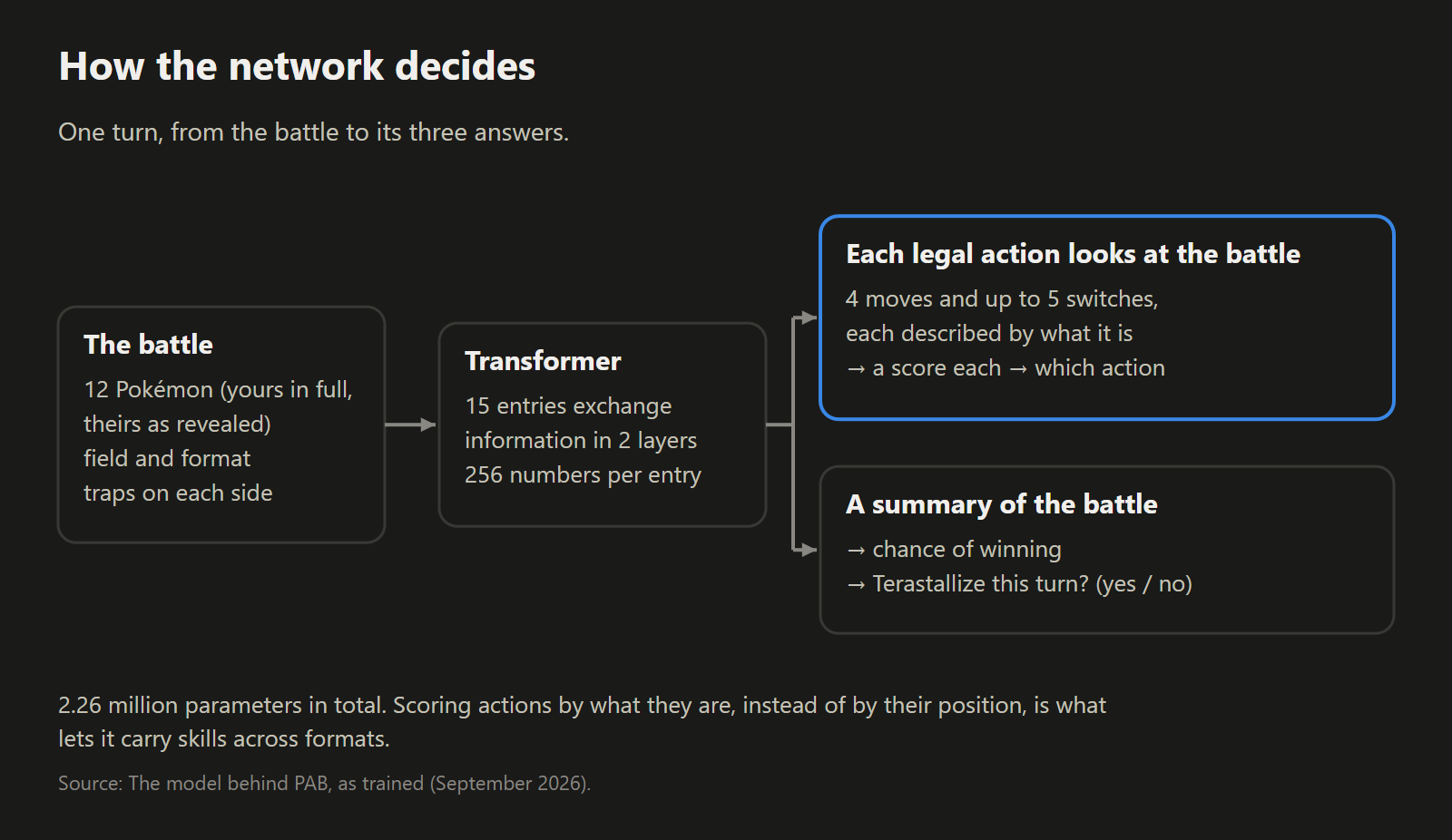
Each of those 15 entries is turned into a list of numbers that the network learns during training: one list per species, per move, per item, and so on. Then a transformer, the same kind of model behind today's language models but tiny, lets the entries exchange information in two rounds (its two layers). After that, each Pokémon's entry also carries what it's facing, what's on the field and what threats are around.
The most important design choice is how the network picks an action. The simple way is to give it 9 fixed outputs, one per button: "first move", "second move"... "fifth switch". Then it has to learn that the first button is Earthquake in one battle and Thunderbolt in the next. PAB does something else: each available action becomes an entry of its own, described by what it is (which move, or which Pokémon would come in). Each action entry then "looks at" the battle, through a mechanism called attention, and gets a score. Actions that aren't legal this turn are removed, and the scores are turned into probabilities.
That way the network learns what an action means, not which button it sits on, and that knowledge carries over between formats. I compared four designs, and this one kept 56% of its skill on a generation it had never seen, against 27% for the button-based version.
The other two answers come from a summary of the whole battle: a small layer turns it into the chance of winning, and another into a yes or no on Terastallizing. Tera is a separate answer because in the game you don't pick Tera instead of a move: you Terastallize and use a move in the same turn.
In total the network has 2.26 million parameters, 256 numbers per entry and two layers.
Step 3: the engine, a reference player, and a fair referee
Around the network there is a lot of ordinary code, which I call the engine. It reads the battle as it happens, keeps track of every Pokémon, lists the legal actions, calculates damage and makes educated guesses about the opponent's hidden information. Three parts are worth mentioning:
- Damage. My damage calculator gives the same results as the one the competitive community uses, on every type matchup I tested. Comparing against it later caught three real bugs, where my numbers were off by 25–33% in specific situations.
- Guessing the opponent's set. A Pokémon's "set" is its combination of moves, item and ability. In battles with random teams, every Pokémon can only carry a limited list of sets, so each move the opponent reveals rules some out. In formats where people build their own teams, the engine uses community statistics on what people usually carry. In the main competitive format of the newest generation, what opponents later revealed was in its list of possibilities 96.2% of the time.
- Tests. The engine has 2,239 automated tests. To check that the tests actually catch mistakes, I used a technique called mutation testing: a tool plants thousands of small bugs in the code, one at a time, and counts how many the tests notice. They catch 88%.
On top of the engine I wrote a hand-made player, a set of rules like "use the move that does the most damage", "heal when you're low" or "don't switch in a Pokémon that is weak to the attack coming". I'll call it the rule-based player. It wins 99% of its battles against a player that picks at random, and about 72% against a player that always uses its strongest attack. It's the yardstick for everything else in this post.
The referee was broken
To compare two players, I make them play each other hundreds of times on the simulator, switching sides halfway, and count wins.
At one point I ran the same comparison three times and got 35.5%, 46.5% and 43.5%. Same players, same settings, results 11 points apart. The cause was the random seed, the number that decides all the luck in a battle. I was fixing it for the battle itself, but each player's team was being picked with a different seed that I wasn't fixing. Every run was playing different battles.
Once I fixed all of them, repeated runs gave exactly the same result. From then on, two versions of a player always face the exact same battles, and I compare them battle by battle: in how many battles did one win where the other lost? That is far more sensitive than comparing two win rates.
A note on the statistics in this post: when I give a p-value, it's the chance of seeing a difference that large by pure luck if the two players were actually equal. Below 0.05 is the usual bar for calling a difference real.
Step 4: copying human players
The first network learned the simplest way: show it a battle situation and ask it to predict what the human did. This is called behavior cloning.
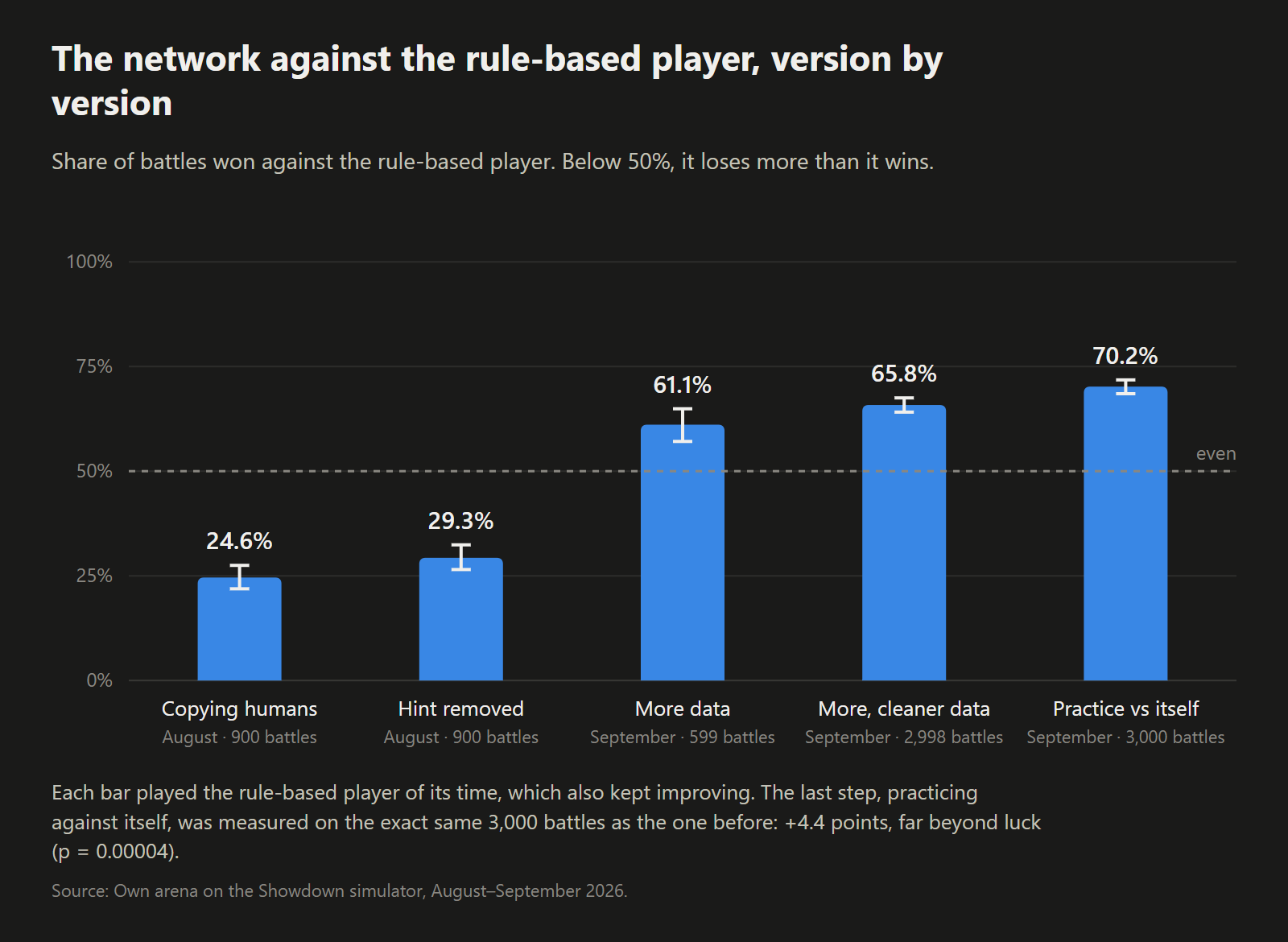
It got good at copying. Half the time it picked exactly the same action as the human. And it won only 39% of its battles against the player that always uses its strongest attack, a player my handful of rules beats 72% of the time.
That was the main lesson of the first month: getting better at predicting what humans do didn't make it play better. People make mistakes, and a network trained to copy them copies the mistakes too.
Two things helped, in this order:
- Removing a hidden hint. The data accidentally told the network which of its options were real moves and which were padding. Taking that hint away made it worse at copying humans and better at winning.
- More and cleaner data. With 6 million decisions and the replay-reading bugs fixed, the network started beating the rule-based player: 61%, then 66%.
How the copying works
Each of the 6.06 million decisions is a question with a known answer: in this situation, among the actions that were legal, the human picked this one. The network's scores are turned into probabilities over the legal actions only, and training nudges it to give more probability to the one the human picked. (The standard name for this objective is cross-entropy.)
Two smaller objectives are trained at the same time, each counting 30% as much: predicting whether that player went on to win the battle, and whether they Terastallized that turn. The second only counts on turns where Tera was available; otherwise the network would learn to always say no.
To check progress honestly, 15% of the battles were set aside and never used for training. The split is by battle, not by decision: decisions from the same battle are so alike that mixing them would let the network recognize the test questions. Training made 14 passes over the data, and I kept the version that did best on the set-aside battles.
On those battles, the final copying network picked exactly the human's action 55.5% of the time, had it among its top three 88.3% of the time, and guessed who would win the battle 75.3% of the time.
Two things that looked promising didn't work out:
- Predicting who will win. I also trained the network to estimate its chance of winning from any position. At first it memorized the training battles: perfect on those, and worse than a coin flip on new ones. Training on more formats fixed that, and after adjusting its numbers, when it said "70% chance to win" it really won about 70% of the time.
- A smarter way to copy. I tried copying humans while giving more weight to decisions that turned out well. The first test looked like a small win. When I repeated it more carefully, with more data, the gain disappeared.
Step 5: practicing against itself
Copying has a ceiling: the network can only get as good as the players it copies, mistakes included. To go further it has to learn from its own results. That is reinforcement learning, and I used a standard method for it called PPO (Proximal Policy Optimization), starting from the copying network. One round of training goes like this:
- Play. The network plays 64 battles against an opponent from its league (more on that below). To explore, it doesn't always take its favorite action: it picks at random, in proportion to its own probabilities, so it sometimes tries something new. The opponent always plays its best.
- Score. The only reward is the result at the end: +1 for a win, −1 for a loss. Every decision of that battle gets the same result.
- Compare with what it expected. Before each decision, the network had already estimated its chance of winning. If the battle went better than it expected, the actions it took get a bit more probability next time; if it went worse, a bit less. Comparing against its own expectation is what separates a good decision from a lucky one.
- Take small steps. In one round, the probability of an action can't move by more than 20% of its value. That limit is the "proximal" in PPO: without it, one lucky round could undo what the network already knew. Each round's battles are used 4 times, with a small learning rate.
It ran for 200 rounds, 12,800 battles in total.
The league. Playing only against its latest self is risky: the network can learn to beat one particular style and forget the rest. So every 3 rounds a frozen copy of it joined a pool of past versions, and each round's opponent was drawn from that pool, more often the ones it was losing to. (The method is called prioritized fictitious self-play.) An Elo rating, like the one used in chess, tracked its progress, measured in separate battles where both sides played their best.
A bug worth telling. The first runs looked unstable: the updates kept hitting the 20% limit. I lowered the learning rate tenfold, expecting things to calm down, and it got worse. The cause was dropout, a training technique that randomly switches off parts of the network. It was on while learning and off while playing, so the "before" and "after" probabilities of the same decision differed even when nothing had been learned yet. Running the updates with dropout off fixed it.
The result: from 66% to 70% against the rule-based player, measured on the exact same 3,000 battles. It was the biggest improvement of the whole project.
Step 6: thinking one turn ahead
The rule-based player and the network both look at the current turn and pick an action. Neither asks "if I do this, what will my opponent do, and where does that leave me?" So the next step was to add that kind of thinking, called search.
A Pokémon turn is a guessing game, a bit like rock-paper-scissors: both players choose at the same time. So the search builds a table with every one of my options against every likely option of my opponent, scores how each combination would turn out, and works out the best way to mix my choices so my opponent can't predict and punish me. Game theory calls that mix an equilibrium. When it says "Earthquake 60% of the time, switch 40%", showing only Earthquake would hide half of the advice, so the panel shows both.
I set a rule for this part of the project: each new step would only go ahead if the previous one beat what I already had. The results:
- On its own, the search tied the rule-based player at 49%. I tuned it by trying 16 different settings, and the best one won 55% in those tests. On fresh battles it went back to 49%. When you pick the best of 16 noisy results, you're partly picking the luckiest one. That's why I always test the winner again on battles it has never seen.
- Using Showdown's real battle code to predict each turn didn't help. My quick approximation agreed with it 85% of the time, and the two played equally well.
- Better predictions didn't help either. This is the result I find most interesting:
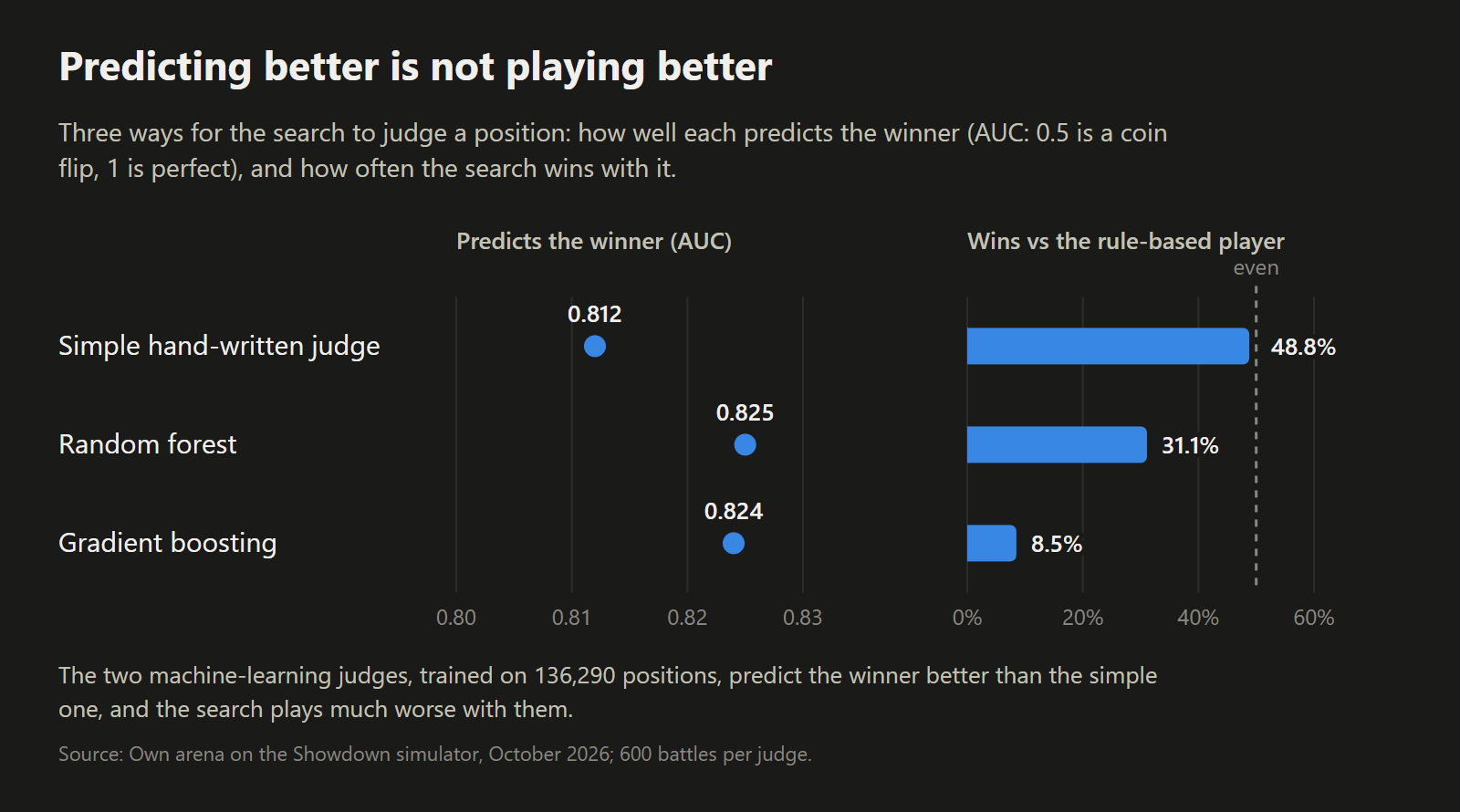
To score each combination in the table, the search needs to judge how good a position is. I compared my simple hand-written judge, which mostly counts health and Pokémon left, with two machine-learning models trained on 136,290 positions. Both models were better at predicting who would win the battle. Put inside the search, both played much worse: they won 31% and 9% of their battles, against 49% for my simple judge. It's the same lesson as copying humans: a better score on a test isn't the same as playing better.
Mixing the network and the search
Then I tried combining the two, in both directions. These tests came a few weeks later, against a rule-based player that had improved in the meantime and with the search on its default settings, so here the search alone wins 43% instead of 49%.
The network learning from the search. I had the search play 10,000 battles against itself, 701,287 decisions in all, and trained the network to make the same choices. Not just the move the search picked: its whole mix, like "60% Earthquake, 40% switch", so the network would also learn when to mix. It used the same objective as copying humans, with the mix in place of a single answer.
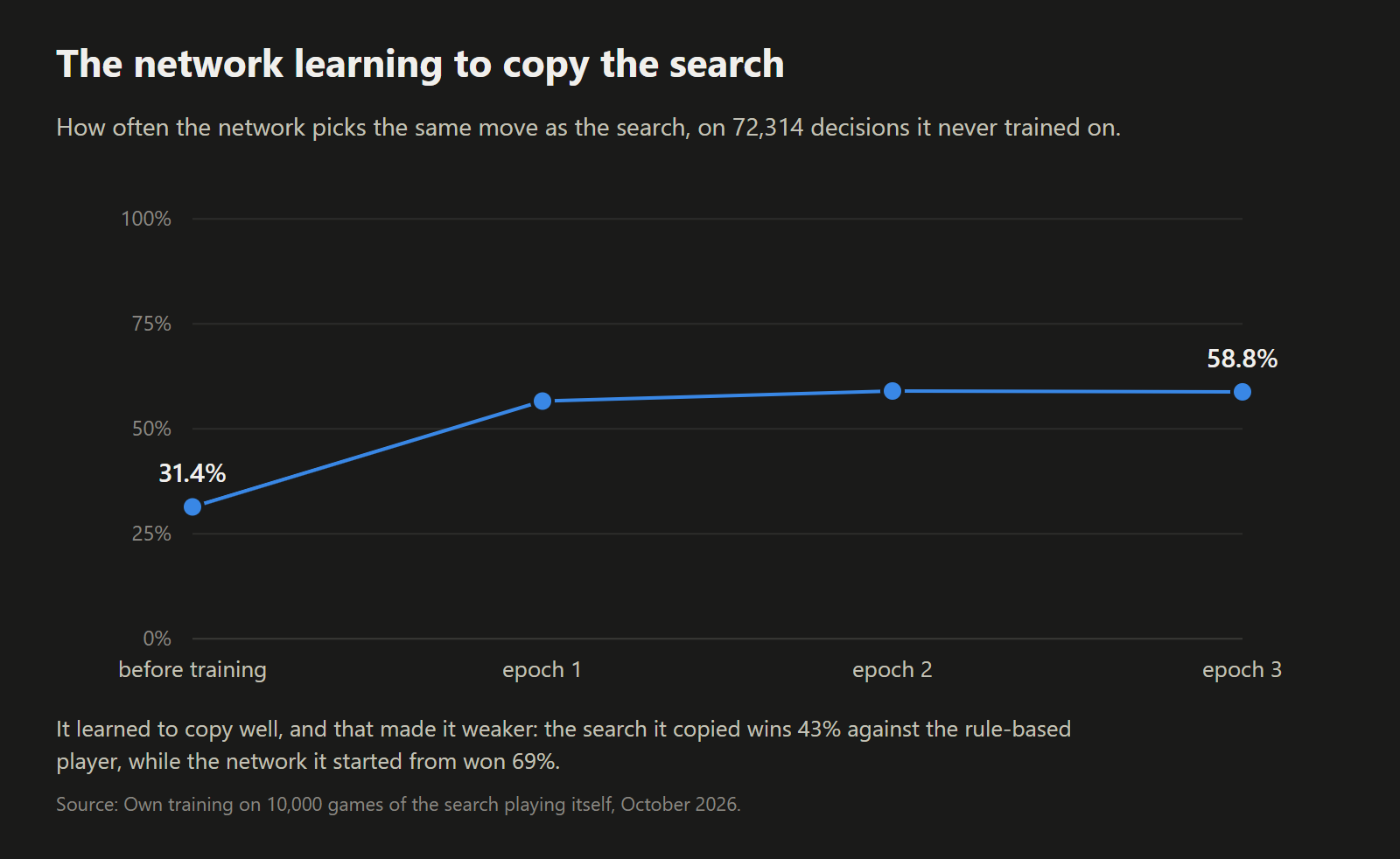
It learned to copy the search well, and that's why it got worse. The search was a weaker player than the network, so copying it made the network play like the search: it went from winning 69% against the rule-based player to 42%.
The search taking advice from the network worked much better:
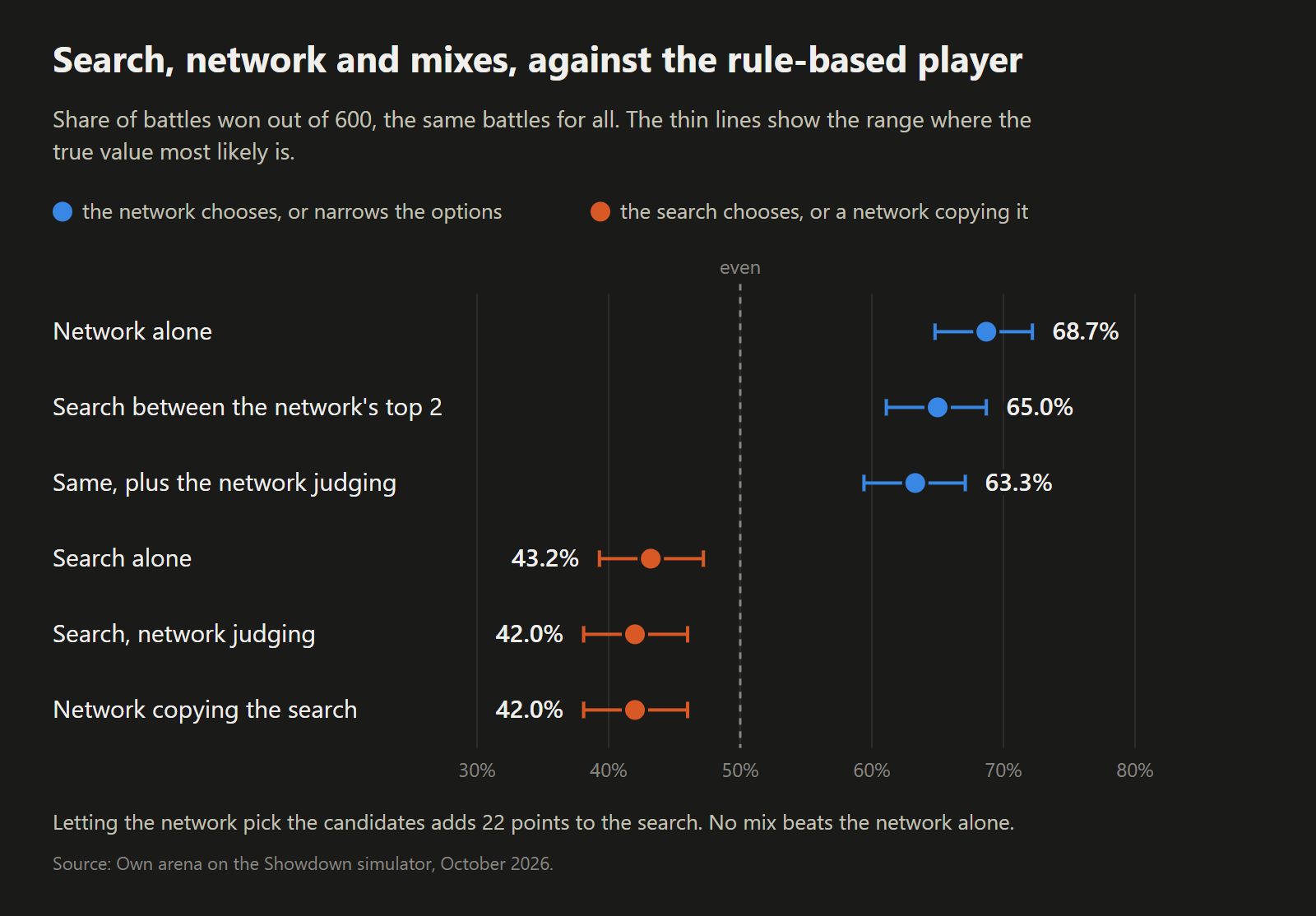
When the network picked its two favorite moves and the search chose between them, the search won 22 points more than on its own. But no combination beat the network playing alone.
The real test, and a bug in the measuring code
Beating my own rule-based player only proves so much. The real test was Foul Play, an open-source bot built to play Showdown. It searches many moves ahead, which makes it a much stronger opponent than anything I had built.
For weeks, my measurements said that against Foul Play, the network and the rule-based player were equally weak: about 16% and 15%. That was strange. The network beat the rule-based player 70% of the time, and yet against a real opponent the difference vanished.
Right before the final measurement, I found out why. The code that let the network play these outside battles had a bug. In the newest generation each attack can also be used with Terastallization, so the engine's list of actions has a second copy of each attack. The network received the list without those copies, but its answers were read back against the list with them. So whenever Terastallization was available, which is most of a battle, the network's scores ended up attached to the wrong actions. In practice it could never decide to switch Pokémon on its own.
The code used for training and for my internal comparisons didn't have this bug, so the 70% against the rule-based player still holds. Only the battles against Foul Play were affected. After fixing it, and measuring the rule-based player again over 250 battles:
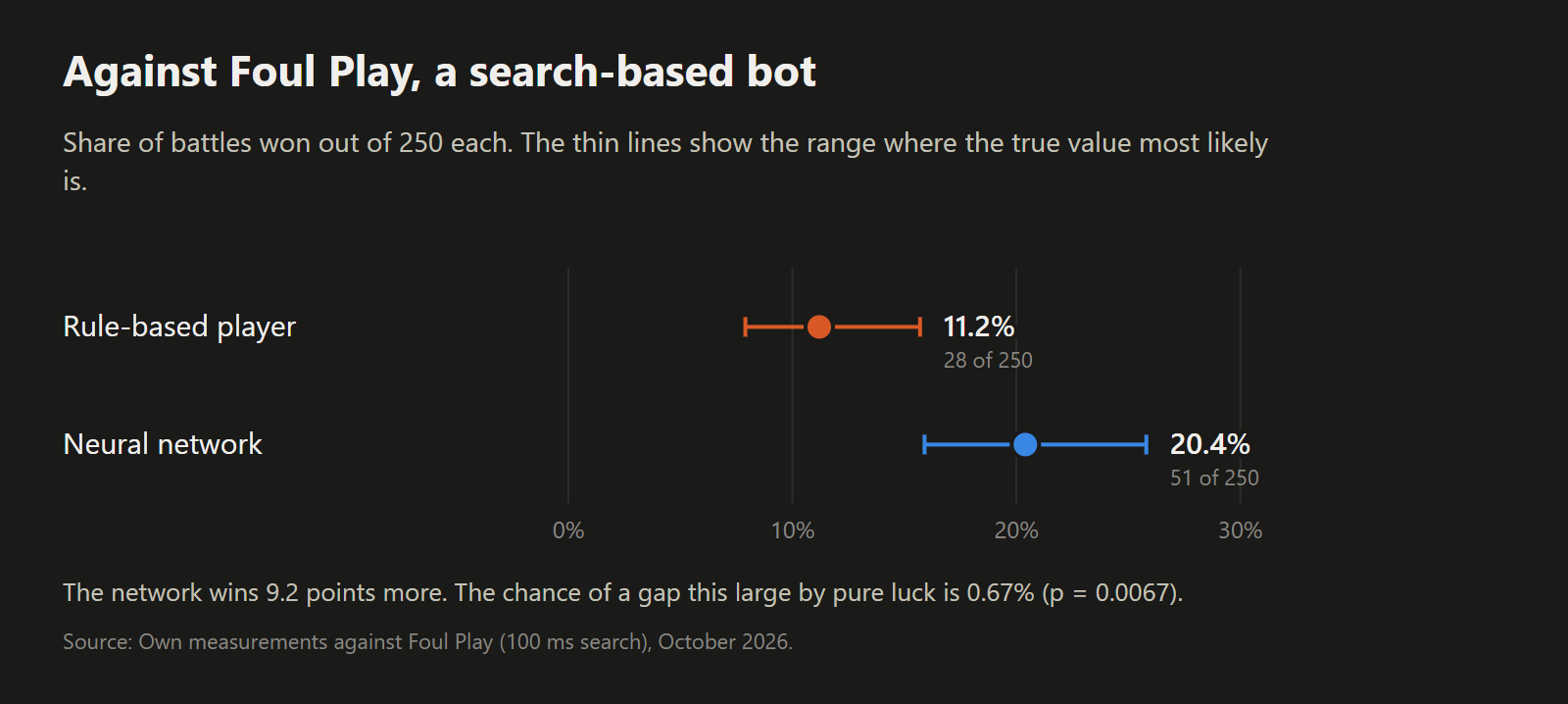
The network won 20.4% of its battles and the rule-based player 11.2% (p = 0.0067). It's the first time something in this project clearly beat the rule-based player against an outside opponent. Both still lose most of their battles against Foul Play, but the gap is real.
The extension
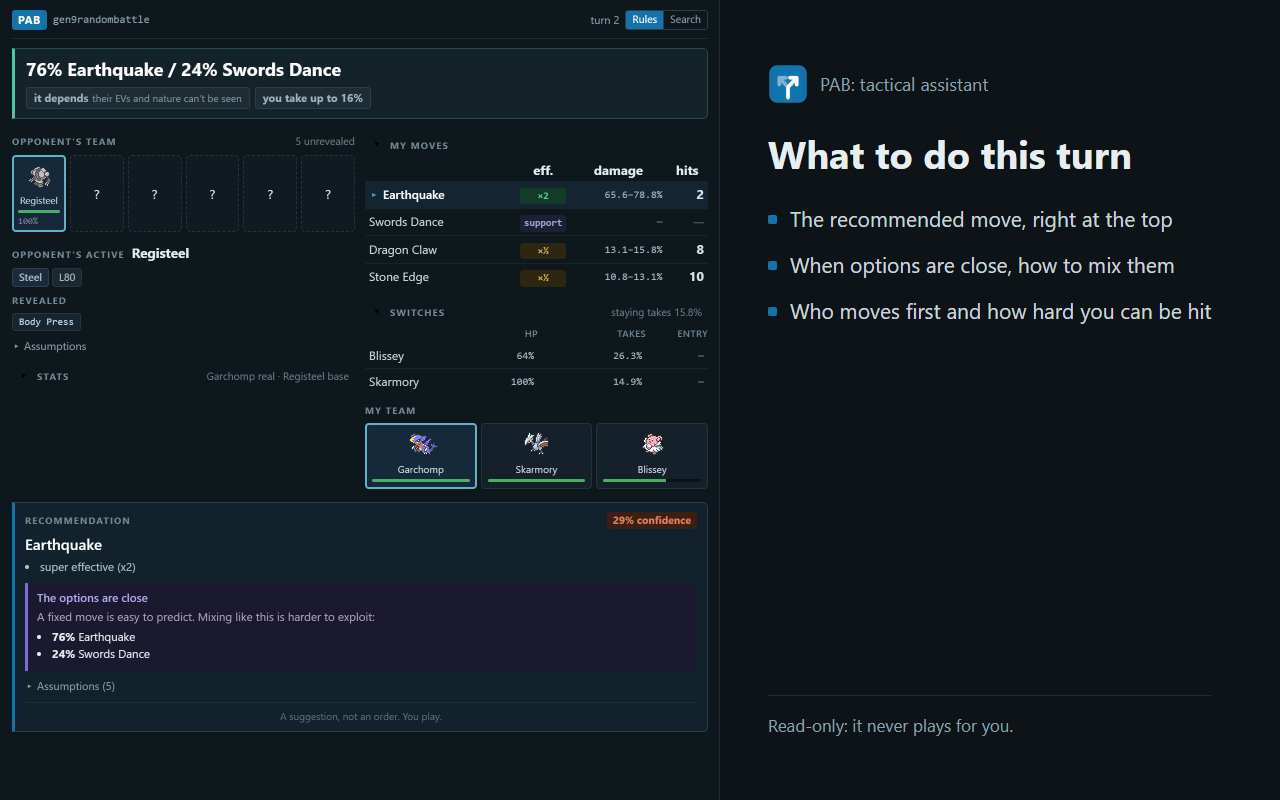
The extension adds a panel next to your battle, as its own tab inside Showdown.
- At the top, a summary: the recommended move (or the mix, when two moves are close), who moves first, whether you can knock the opponent out, and whether they can knock you out.
- Below, tables you can fold away: the damage of each move, how much each Pokémon on your bench would take if you switched in, and stats.
- What your opponent is probably carrying, with the options that have been ruled out, and fields you can edit when you know better.
- Two ways to decide, with a switch at the top of the panel: "Rules", the rule-based player, which is the default, or "Search", which explains itself in terms of your opponent, for example "if they use Magma Storm, you come out ahead". It takes 3 to 4 milliseconds per turn in the browser.
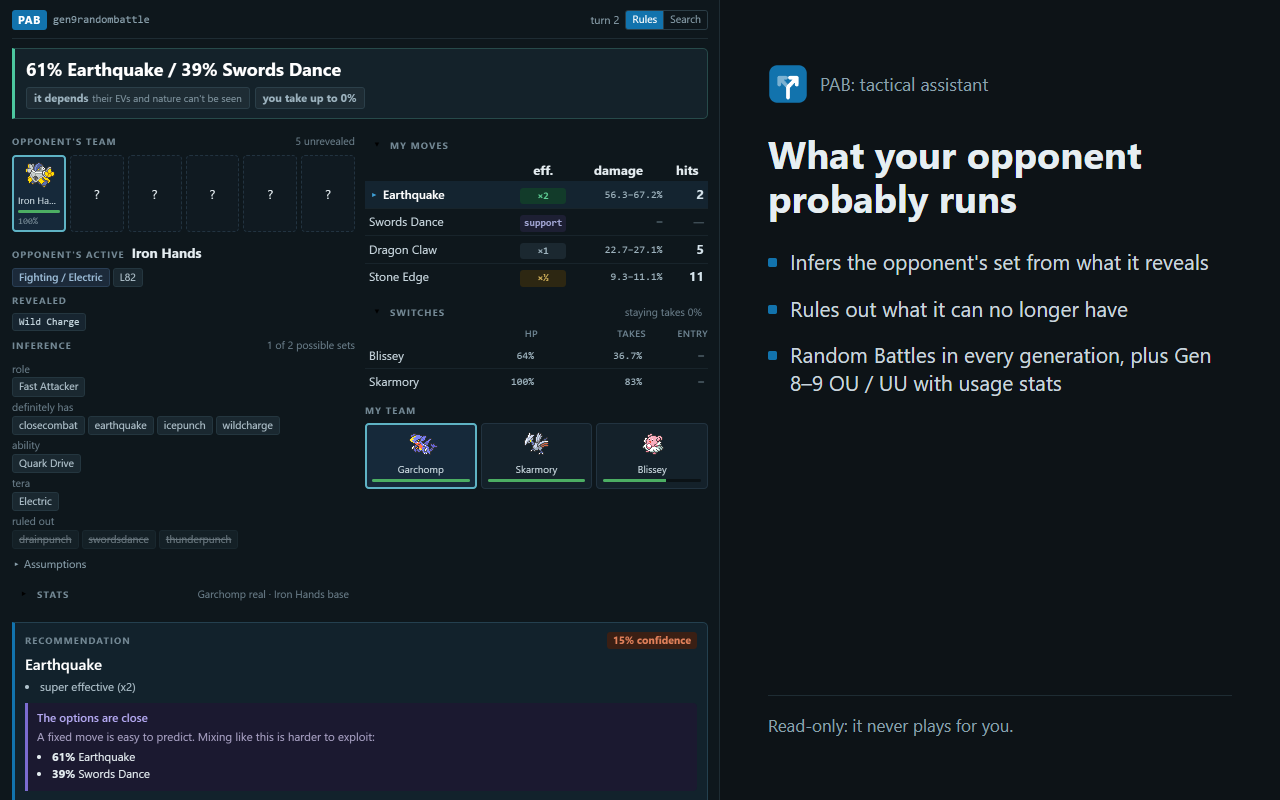
The first version put the recommendation at the very bottom, under four tables. After using it in real battles I found it had a lot of information and very few clear signals, so I redesigned it in eleven small steps, borrowing interface ideas (but no code, because of its license) from Showdex, an extension many Showdown players already use. The panel got about a quarter shorter, and it no longer needs scrolling in any of the situations I test.
Two problems from building it:
- The panel was empty in Showdown's new interface. The new version of the site handles its connection in a background process, out of reach of the part of the page the extension was watching. I made the extension watch that background process too, still without being able to send anything, and added an automated test against the real Showdown site so it can't break silently again.
- The network doesn't fit in the extension. It's 9 MB, the whole extension is 2 MB, and compressing the network broke it. So the extension uses the rule-based player by default, and the network stays on my computer for now.
The extension is called "PAB: tactical assistant". I left "Pokémon" out of the name, since it's a trademark. I submitted it to the Chrome Web Store on 20 October, and it's under review.
What I learned
- Measure the thing you actually care about. Copying humans better, predicting the winner better and copying the search better all made the player worse at winning.
- Check the measuring tool before trusting the result. The two biggest surprises of the project were bugs in the code that measured things: the random seed that didn't fix the teams, and the scores attached to the wrong actions. Both produced believable, wrong numbers for weeks.
- Decide what counts as success before you test. Several steps of the project didn't pass their own bar, and that was useful too: it told me where not to spend the next month.
- Let your experiments prove you wrong, even about being wrong. Five of my design decisions turned out to be mistakes. Two of my corrections were also wrong, and only measuring again showed it.
What's next
- Thinking two turns ahead, with the network's advice. The one thing this project never tried is looking further ahead.
- More practice games, using Terastallization. The network learned when to Terastallize from human replays, but its practice games never used it.
- The network inside the extension, which means making it smaller.
- And waiting for the Chrome Web Store review.